

DBM Putty
Choose File
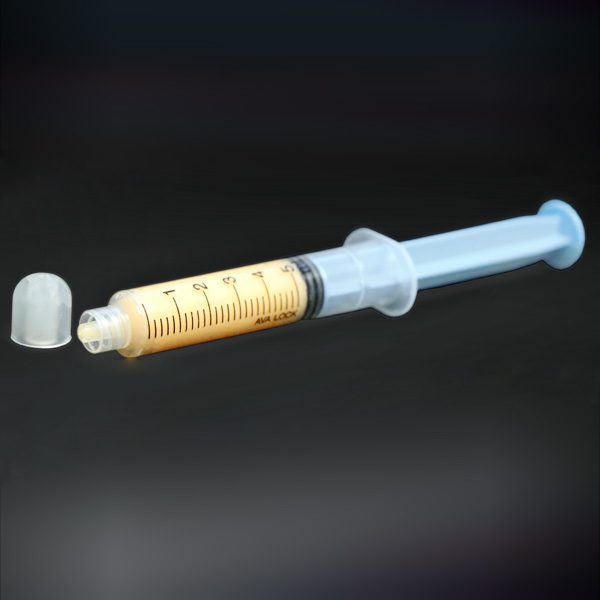
Demineralized Bone Matrix (DBM) Putty is a specialized bone graft material widely used for managing bone defects during surgical procedures. This product is composed of demineralized bone powder with particle sizes under 500 micrometers and incorporates a hyaluronic acid carrier. Acting as a biocompatible carrier, hyaluronic acid provides hydration and moisture retention, enhancing the physical environment and thereby facilitating bone tissue regeneration.
DBM Putty is sourced from human demineralized bone powder and contains type I collagen along with non-collagenous proteins such as osteocalcin, osteonectin, and glycosaminoglycans. It is presented as a soft, moldable scaffold with both osteoconductive and osteoinductive properties. These characteristics make DBM Putty an ideal matrix for the attachment, proliferation, and differentiation of bone cells, supporting the formation of new bone tissue.
This product offers several advantages over other similar graft materials. Its osteoconductive property allows seamless integration with surrounding bone tissue, while its osteoinductive capacity promotes the production of bone-forming proteins, thereby accelerating the bone regeneration process.
Due to its structural composition and active proteins, DBM Putty should be stored in a refrigerator at 2–8 °C, with a shelf life of up to six months from the date of manufacture. High biocompatibility and its ability to enhance bone regeneration make DBM Putty a preferred choice among orthopedic and spine surgeons as well as dental specialists
Quick Access Menu
Product Description
Key Feature of Demineralized Bone Matrix (DBM) Putty
The primary feature of DBM Putty is its osteoinductivity, which ultimately promotes osteoregeneration and the repair of the damaged area. Additionally, the soft-tissue phase present in its structure supports optimal regeneration of surrounding soft tissues. It is important to note that after passing all in-process quality controls, the final product undergoes gamma irradiation to ensure complete safety. This sterilization process may induce minor structural changes but does not compromise the fundamental collagenous and mineral matrix.
Active and Biocompatible Components
DBM Putty contains type I collagen, osteocalcin, osteonectin, and glycosaminoglycans, which naturally accelerate bone growth and regeneration.
Hyaluronic Acid Carrier
Hyaluronic acid acts as a biocompatible carrier, providing a moist and ideal environment for the proliferation and differentiation of bone cells, enabling faster repair of bone defects.
Soft, Moldable Structure
The soft, scaffold-like design of DBM Putty ensures easy handling during various surgical procedures and provides a suitable matrix for bone cell attachment and growth.
Advantages and Applications
Osteoconductivity: DBM Putty integrates seamlessly with surrounding bone tissue, offering an ideal scaffold for new bone formation.
Osteoinductivity: By stimulating the production of bone-forming proteins, it accelerates the regeneration of damaged bone tissue.
Ideal for Orthopedic Surgeons and Dentists: High biocompatibility and proven effectiveness make it a preferred choice in specialized surgeries.
Storage and Handling Considerations
Storage Conditions: To maintain efficacy, DBM Putty should be stored in a refrigerator at 2–8 °C.
Shelf Life: The product is usable for up to 6 months from the date of manufacture.
Why Choose DBM Putty?
With a combination of active proteins, scaffold structure, and osteoconductive and osteoinductive properties, DBM Putty offers a reliable and effective solution for surgeons. If you are looking for a product with proven performance in bone regeneration, DBM Putty is the ideal choice.
The key features of demineralized allograft products include their osteoinductivity, which promotes osteoregeneration and facilitates the repair of damaged areas. Additionally, the collagen skin strings within the structure contribute to optimal repair of surrounding soft tissue. It is important to note that, following thorough monitoring throughout the processing, gamma irradiation is conducted on the final product to ensure its safety. This irradiation does not compromise the nature of the product, including its mineral and collagen matrix, although there may be slight structural modifications.
Product Code | Product Name | Therapeutic Area |
|---|---|---|
5070064 | Wet Carrier DBM Putty V:0.5 cc | Dental, Orthopedic |
5070065 | Wet Carrier DBM Putty V:1 cc | Dental, Orthopedic |
5070066 | Wet Carrier DBM Putty V:2 cc | Dental, Orthopedic |
5070067 | Wet Carrier DBM Putty V:5 cc | Dental, Orthopedic |
Contact us
Get expert advice
Contact our experts for free guidance and advice, or read our About Us page to learn more about us.
Related content




Description
Some of our products
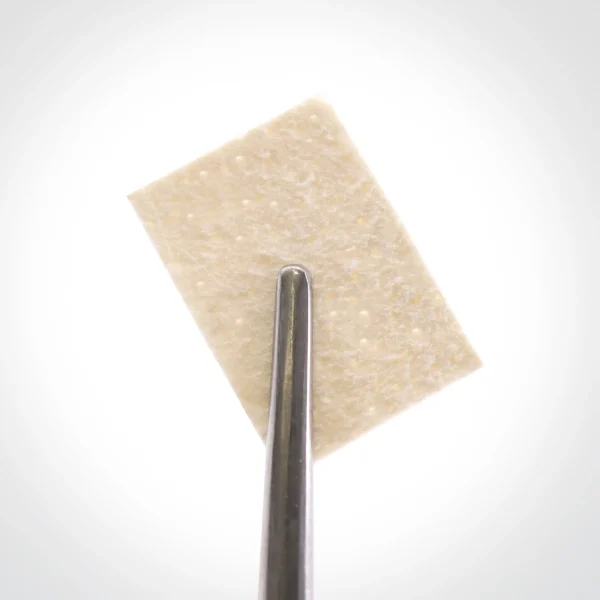
The acellular dermis membrane collagen membrane, contains basement membrane on one of its surfaces. It can provide a dense and impenetrable layer against microorganism and pathogen penetration into deeper layers.
So the membrane surface can stay exposed in high-perfused tissue of the oral cavity. The product origin is the collagen membrane (skin dermal layer), which consists of strong collagen type I and III fibers that strengthen the product, and also elastic fibers causing flexibility. This collagen membrane results in product’s unique features.
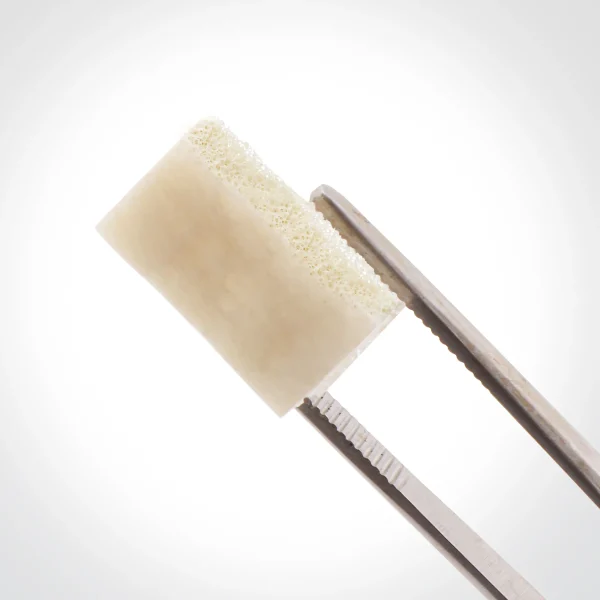
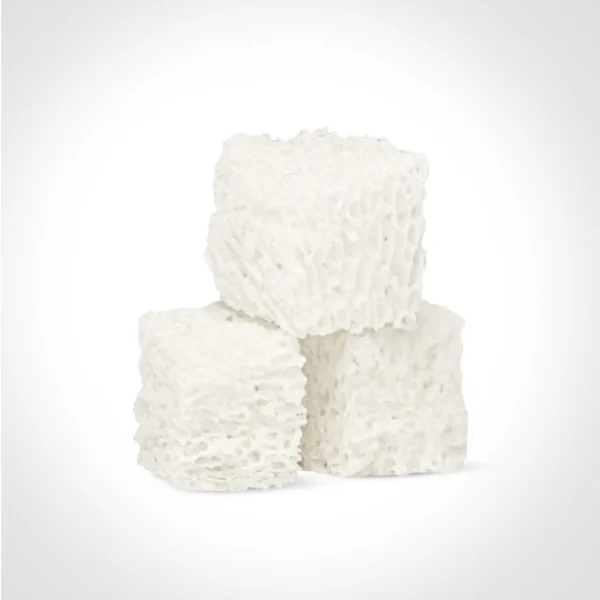
Freeze-dried bone allograft as Bone grafting such as Cube, Matchstick and Block forms has revolutionized orthopedic and maxillofacial surgeries, offering distinct advantages due to their unique compositions. Cube and Matchstick configurations consist solely of cancellous bone, while block formations comprise a core of cancellous bone enveloped by a cortical surface. These allograft are meticulously processed to decellularization and ensure sterilization. The resulting grafts provide essential structural support and seamlessly integrate with the recipient’s bone, promoting the formation of new bone.
Cube and block bone allografts effectively address osseous deficiencies caused by various conditions, from post-traumatic injuries to degenerative diseases and reconstructive procedures. In dental implantology, they serve as a reliable scaffold for augmenting deficient mandible and maxilla structures and facilitating successful implant placement. Moreover, in reconstruction surgeries, these grafts significantly contribute to restoring maxillofacial and skeletal, enabling patients to regain both physical form and function.
Ongoing refinement of bone grafting techniques, along with continued research and innovation, will further enhance the applications and outcomes of cube and block bone allografts, elevating the standard of care in orthopedic and maxillofacial surgeries.