

Bilayer Wound Dressing Composed of Allograft Collagen-Glycosaminoglycan and Silicone
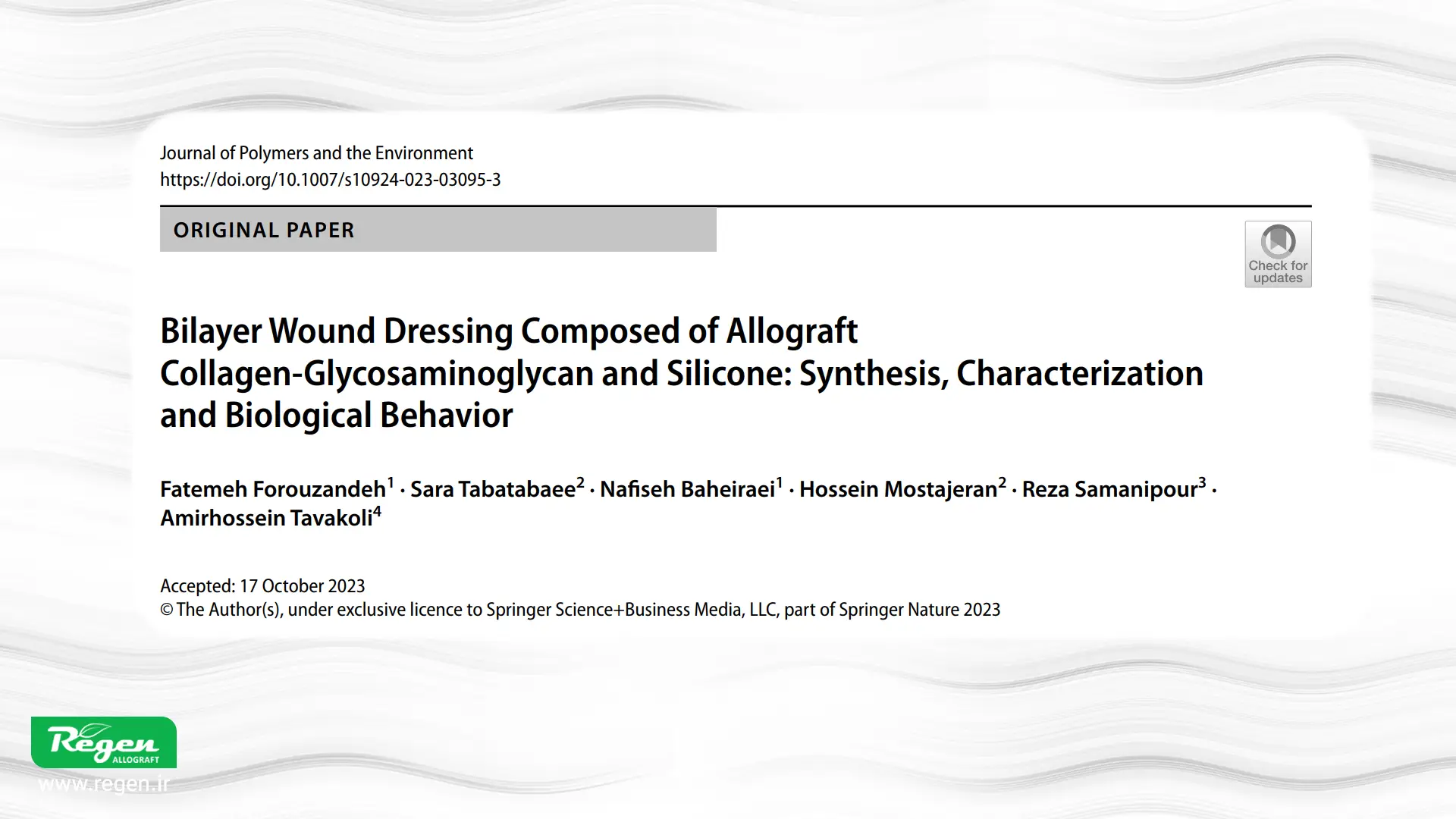
پانسمان زخم دولایه مبتنی بر کلاژن-گلیکوزآمینوگلیکان آلوگرافت و سیلیکون: ساخت، ارزیابی ساختاری و عملکرد زیستی
Bilayer Wound Dressing Composed of Allograft Collagen-Glycosaminoglycan and Silicone: Synthesis, Characterization and Biological Behavior
Fatemeh Forouzandeh, Sara Tabatabaee, Nafiseh Baheiraei, Hossein Mostajeran, Reza Samanipour & Amirhossein Tavakoli
Journal of Polymers and the Environment
https://doi.org/10.1007/s10924-023-03095-3
چکیده
بازگرداندن عملکرد فیزیولوژیکی پوست آسیبدیده بهدلیل نقش غیرقابلانکار محافظتی و همچنین جنبههای زیباییشناختی آن، امری حیاتی است. در این مطالعه، یک داربست نوین دولایه و فریز-درایشده متشکل از کلاژن آلوگرافت و گلیکوزآمینوگلیکان (Col-GAG؛ لایه داخلی زیستسازگار) که با استفاده از ژلاتین بهعنوان چسب زیستی به سیلیکون (لایه تقویتکننده مکانیکی) متصل شده بود، تهیه شد تا از مزایای هر دو منبع (انسانزاد و سنتتیک) بهرهبرداری شود. ویژگیهای ساختاری این داربستها با استفاده از پراش پرتو ایکس (XRD)، میکروسکوپ الکترونی روبشی (SEM)، آزمون کشش، بررسی رفتار جذب آب و قابلیت نفوذپذیری بخار آب (WVP) مورد ارزیابی قرار گرفت. همچنین، زیستسازگاری سلولی این داربستها از طریق کشت فیبروبلاستهای پوستی انسانی (HDF) بر روی نمونهها بررسی شد. علاوه بر این، ارزیابی عملکرد درونزنده (in vivo) از طریق کاشت داربستها در موشهای نر و بررسی سلولسازی و رگزایی با استفاده از رنگآمیزی هماتوکسیلین-ائوزین (H&E) و نشانگر CD31 انجام گرفت. بر اساس نتایج، داربستهای بهاحتمال زیاد آمورف دارای ساختار متخلخل سهبعدی با منافذ بههمپیوسته و با جهتگیری تصادفی بودند که برای رشد سلولی مناسب است. کاربرد لایه سیلیکونی باعث مقاومت در برابر فشار اسمزی اضافی مولکولهای آب، کاهش نسبت جذب آب به 59.2 ± 0.33%، حفظ نرخ نفوذپذیری بخار آب در محدوده تقریبی 0.1–10 میلیگرم بر سانتیمتر مربع بر ساعت، و افزایش استحکام کششی به 1.66 ± 0.12 مگاپاسکال شد. گرافتها محیطی بهینه برای اتصال سلولی فراهم کرده و پس از 72 ساعت، زیستپذیری سلولی بیش از 70٪ را نشان دادند. ارزیابی درونزنده نیز مکانیابی بهتر در اطراف رگها را به همراه داشت و نرخ مهاجرت سلولی حدود 64٪ را نشان داد. نتایج نشان داد که داربست بهدستآمده، پتانسیل بالایی بهعنوان یک پانسمان زخم ایدهآل دارد.
Abstract
Restoring the physiological function of the damaged skin is crucial due to its undeniable protective role as well as its aesthetic aspects. Herein, a novel bilayer freeze-dried scaffold comprised of allograft collagen and glycosaminoglycan (Col-GAG; the biocompatible inner layer) adhered to silicone (mechanically reinforcing component) utilizing gelatin as the bio-glue was prepared to benefit from each origin (human-derived and synthetic) advantages. The structural characterizations of the scaffolds were analyzed by X-ray Diffraction (XRD), Scanning Electron Microscopy (SEM), tensile stress test, water uptake behavior, and Water Vapor Permeability (WVP). Also, the scaffolds’ cytocompatibility was assessed by culturing human dermal fibroblasts (HDF) on the samples. Furthermore, the in vivo functionality was performed by implanting the scaffolds in male mice and observing the cellularization as well as neovascularization by Hematoxylin and Eosin (H&E) staining and CD31 marker. Based on the results, the potentially amorphous scaffolds were three-dimensional (3D) porous with randomly oriented interconnected pores suitable for cellular ingrowth. The application of the silicone layer resulted in resisting the extra osmotic pressure of water molecules by decreasing the water uptake ratio to 59.2 ± 0.33%, maintaining the WVP at an approximate rate of 0.1–10 mg/cm2hr, and boosting the tensile strength to 1.66 ± 0.12 MPa. The grafts provided an optimum environment for cell attachment and presented cellular viability upper than 70% after 72h. In vivo assessment exhibited improved perivascular localization, with the cell migration rate approximating 64%. The outcomes indicated that the achieved scaffold holds promise as an ideal wound dressing.
مقالات مرتبط
این مطلب چقدر مفید بود؟
برای امتیاز دادن، روی یک ستاره کلیک کنید!
میانگین امتیاز 5 / 5. تعداد امتیازها 1
شما اولین نفر باشید که امتیاز می دهید!
مطالب مرتبط


مشاوره رایگان
به مشاوره نیاز دارید؟
کادر حرفه ای و تخصصی شرکت فرآورده بافت ایرانیان آماده راهنمایی شما عزیزان می باشند